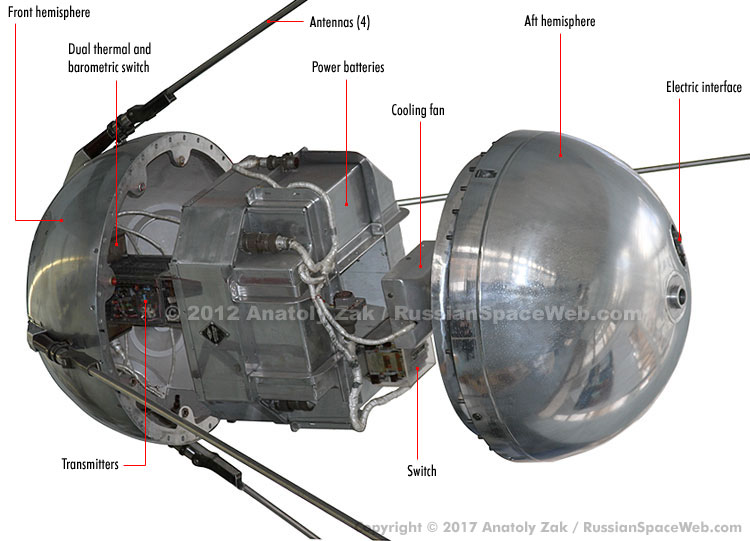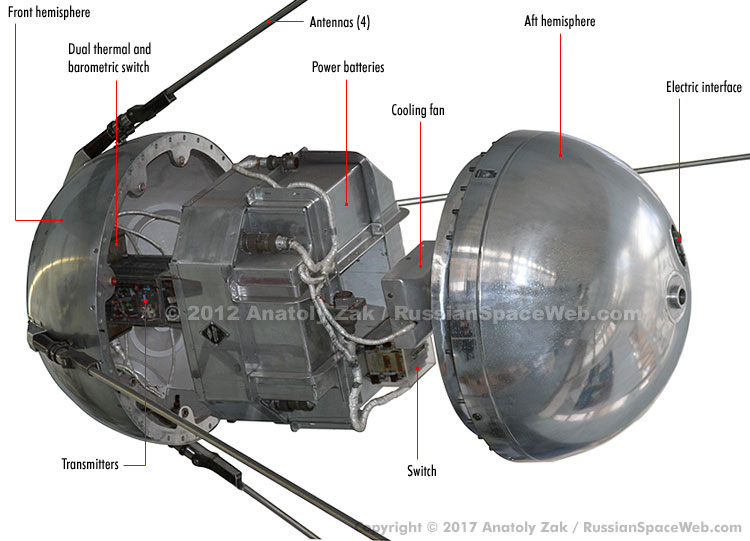
I was born years after the Sputnik 1 was launched into space by the Союз Советских Социалистических Республик (Union of the Soviet Socialist Republics in English) or just the Soviet Union, on 4 October 1957 at 19:28:34 UTC. Singapore was under a partial self government and would become the State of Singapore jointly managed by Singaporeans and the British. What happened following the establishment of the State of Singapore is left as a history lesson to the reader to explore.
Let’s get back to the Sputnik 1, or just Sputnik. The Sputnik, a 83.6kg craft, sent signals via its 1 watt radio, back to Earth for about three weeks before its three silver-zinc batteries became depleted. With no more propulsion power, aerodynamic drag caused it to fall back into the atmosphere on 4 January 1958 and from all accounts, it burned up.
In Russian, Sputnik actually means “fellow traveller” which implies an artificial satellite or a natural satellite in Russian. But, Sputnik became the term in English to describe that spacecraft and it has stuck.
It is useful to get some historical insights on what lead to the launch. In 1952, the International Council of Scientific Unions decided to declare July 1, 1957 to December 31, 1958, as the International Geophysical Year (IGY). This was because scientists knew that the cycles of solar activity would be at a high point then. Then in October 1954, the council adopted a resolution calling for artificial satellites to be launched during the IGY to map the Earth’s surface.
While the US, the USSR and others were working on each launching satellites, the USSR’s launch of the Sputnik 1 came as a surprise – although, it is hard to say it was entirely a surprise as it was all in the IGY plan.
I would posit that the phrase “Sputnik Moment” was coined because, even though the members of the ICSU were aware of that there are efforts underway to launch something, it is possible that the Soviets went ahead and just did what they could, perhaps for the prestige of being the first. I don’t think there was a “surprise” element, although seems to the commonly accepted narrative.
Suffice to say, the “Sputnik Moment” pushed the US to establish the National Aeronautics and Space Administration in October 1958. That effort has driven a huge amount of innovation in all areas of society, industry and science – velcro anyone?

So what?
Well, all that to bring us to today, 3 February 2025 – not actually today, but the last week of January 2025; but details.
Why? “The sky is falling” as said by Henny Penny aka Chicken Licken aka Chicken Little narratives (not to be confused by Jay Sean’s hit) by many entities, primarily in the US, because a group of techies figured out a cheaper and simpler/simplified way to train foundational or large language models based on well known and established techniques like distillation and Mixture of Experts. And that work was then released on Huggingface.co under an MIT License.

I welcome DeepSeek.com‘s release of their model code under an open source license.
In the days when the starting point of any software was the source code that would have sufficed.
But, in the world of foundation models, life starts with the data used to train and build the model code.
DeepSeek has yet to release the data.
The DeepSeek V3 technical report does not state where the training data was from, and without that knowledge and the ability to inspect and check the training data, DeepSeek is definitely NOT open source.
To be labelled as open source, the training data PLUS the model code need to be made available on an open data license and open source license. Having only one and not the other is insufficient.
It is worth repeating and acknowledging that DeepSeek did release the model code on the MIT license. They could, sort of, claim to be “open core” instead.
But, open core is NOT open source at all. Open source carries more credibility and real world proof of success.
Credibility built up over decades of proving how software like Linux, webservers, programming languages, compilers, Firefox, chat tools, Pytorch, MariaDB, PostgreSQL, LibreOffice, NextCloud, Jitsi, and thousands of open source software are robust, works reliably and has created vast fields of endeavour and enterprise like the Internet, the “cloud” etc is on show for all.
Everything we see today with Artificial Intelligence (I’d rather use Augmented Intelligence) could not have happened without open source software. Yes, it is a bold statement and I will stand by it. Go ahead and check for yourself. Or if you have 30 minutes, watch this talk I gave at FOSSAsia 2024 in Hanoi “A (brief) History of AI“:
Where have reached now? We know that open source is a very powerful software development model – proof is all around. Everyone wants to get in on it, even those, like Meta/Facebook, who would rather lie about being open source, just to get some attention. Yes, Meta’s llama has a license, but it is not an open source license – they made one up.
Meta, like DeepSeek, could have just said that they are open core, but, as one already knows, open core has very little credibility, so they rather lie and claim open source.
Was DeepSeek the Sputnik Moment?
No. There was NO surprise. It was expected. We all knew and anticipated it. The US “techbros” kept pushing the narrative that only they were in this game and pushing the boundaries and everyone else was years behind. As the CEO of my first company, Mr JM, told me, “when we start believing the marketing BS of our company, we are doomed.”
It is NOT at all a Sputnik Moment, because all DeepSeek did was to take known techniques of model training and applied it. It is mathematics and software. Any one could have done what they did and given the constraints they were placed under by being denied access to higher performance hardware, they invoked the old saw, “necessity if the mother of invention”.
While the likes of FauxOpenAI were going around amassing billions of dollars, give a bunch of smart, dedicated geeks and engineers who are placed in a constraint to do good work and show up the hype.
When all you keep hearing is that we need “lots of data”, “lots of hardware”, “lots of electrical power”, “lots of water”, “we have to work the Scaling Law”, “lots of data centres” etc, it reminds me of a person who only has a hammer and so to that person everything is a nail. If you only step back, employ systems thinking, you too could come up with what DeepSeek’s engineers did or better. I am sure there are many efforts around the world to do exactly that.
And do note that for all the good that the DeepSeek engineers have done with using proven techniques to get better performance, their model has questionable issues. See my post from a month ago.
Remember, as Newton seems to be credited to have said, “standing on the shoulders of giants” is what we are doing with open source development.
Thanks for reading this far and I would like to invite you to consider this course I am going to run in April at the Singapore Institute of Technology entitled: “Chief Open Source Officer“. We really do need to educate as many c-suite people as possible on how powerful open source collaboration is and how we can all collectively progress rapidly.