ChatGPT was released on 30 November 2022.
Over the last three years and five months, there has been significant enthusiasm and innovation around what it means to be able to use and deploy generative AI technologies based on the transformer model – and a whole lot of hype, outlandish claims and billions in investment dollars.
This is an example of the Cambrian period which sees the enormous proliferation of ideas, techniques, software, hardware, policies and a general seeping into the wider population about what this technology can offer AND, more importantly, what it CANNOT.
Let’s consider where we are today.
All the technologies that mankind has created/discovered/innovated, from fire, to wheels, to writing, to the Internet, to the web, to nuclear systems, to space travel, to medical innovation are all fundamentally, deterministic.
What does deterministic mean? Determinism in this case is not about free will. Determinism here is about whether, say, a switch is on or off. Or in the presence of gravity, where would the objects in the gravitational field move to. All, or most of it, can be computed very precisely. The recent launch of NASA’s Artemis II to circumnavigate the Moon and return is an example of how determinism plays out.
When you then cast your consideration to the generative AI tools with language models – LM – both large and small – and how those work, nothing in it is deterministic.
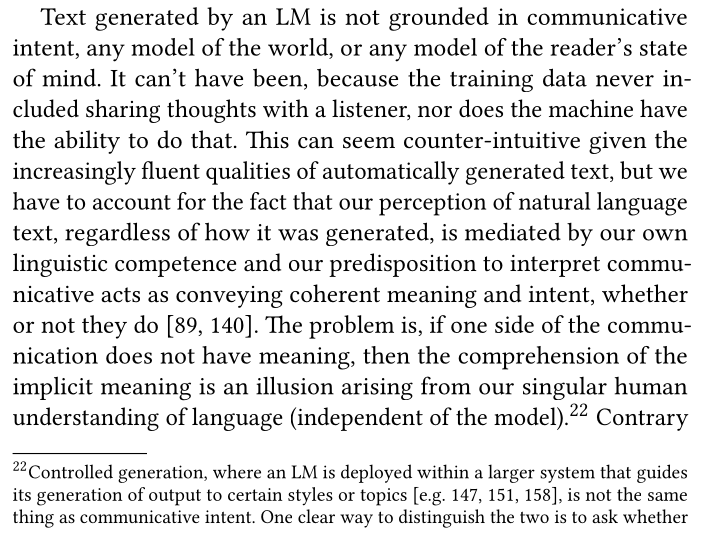
These LMs are fully probabilistic and this 2021 ACM paper entitled: “On the Dangers of Stochastic Parrots: Can Language Models Be Too Big? 🦜” by Emily M. Bender, Timnit Gebru, Angelina McMillan-Major, and Margaret Mitchell describes and highlights the risks associated with the technology. I’d highly recommend reading the paper as it encapsulates a lot of what we see today in LMs and tools that have been built using them. Note that the paper was written and published in March 2021 (a full 18 months before ChatGPT was released) and still holds lots of insights that are current and valid.
In all previous technology adoption by corporations, there really was very little that went into a proper systems thinking approach to why those technologies were needed and if it was indeed needed, how should the organization be modified to adapt/adopt the technology.
A lot of organizations fail to undertake a proper review of what they are doing TODAY and to determine where they’d want to head to with the adoption of new ideas and technologies.
We have been using the term “Digital Transformation” or sometimes just DX to describe the process.
Frankly, the vast majority of digital transformation initiatives were done on a piecemeal basis without a coherent understanding of a) why the transformation is needed and b) who would be part of the decision making and implementation process. Granted there would be much evidence of b) but little of a).
Or to put it another way, the “why” of transformation was never sufficiently documented and articulated. A lot of it is hidden behind vague goals that no one in the decision making rungs of organization could articulate with clarity and yet, they expect those who have to do the work to figure out what it is. That alone explains the large number of failures of digital transformation projects over the last three decades.
And all of that was about the use and deployment of deterministic technologies.
Nondeterminism and Probability
With that bit of background, the challenge we have with organizations pursuing generative AI approach to bring benefits to their organizations is that, they will continue to not fully articulate exactly why they want to do this and who would be part of the stakeholders and decision makers.
And, even if they somehow managed to get both parts figured out, by the very nature of generative AI solutions, the technology will force a complete re-evaluation of who they are, what business they are in and how would the adopt/adapt.
Generative AI is a fundamentally different technology.
AI itself is a very large umbrella of techniques and tools. Within that large collection, generative AI is qualitatively different. Different because it is probabilistic.
As noted earlier, every technology that the human species has built is deterministic. Generative AI is the single technology that is entirely outside that realm.
Hence, we cannot approach generative AI solutioning with the type of thinking that we’ve done with all of the previous technologies.
This requires a considered and carefully thought-through approach. That approach is called Systems Thinking.
Piecemeal implementations of generative AI solutions in any organization will necessarily fail if the rest of the organization is not considered. It might show some value, initially and for a while after that, but any success at the start, is not a guarantee of long term success if the system as a whole is ignored.
Systems Thinking
Why Systems Thinking? It forces the organization as whole (the system) to look at all aspects of what it does, how it does, the value is generates (for the leadership, for the associates, for the business partners, for society etc).
As one part of an organization incorporates generative AI solutions and processes, other parts have to adapt or become the blockage or roadblock.
All job scopes need to be redefined. Workflows need to be reassessed when generative AI methods are used. Yes, even corporate leadership job scopes have to be redefined. Insulating the organizational leadership from generative AI methods is a recipe for failure.
There will be, naturally, resistance in this. It is only expected and must not be ignored. The livelihoods of millions of individuals are at stake as more and more processes get genAI-ed (yes, I’ve just coined it). Even as new job roles and opportunities could get created, the immediate disruption is a society fracturing event.
If Systems Thinking is not undertaken, with full transparency and inclusiveness of the various stakeholders in an organization, expect significant friction to happen, the adoption of “shadow AI” and subtle sabotage of any genAI initiative.
All images are generated via reve.com and are on a CC0 license.
 life one-dot-two degree north, one-o-three-dot-eight degrees east